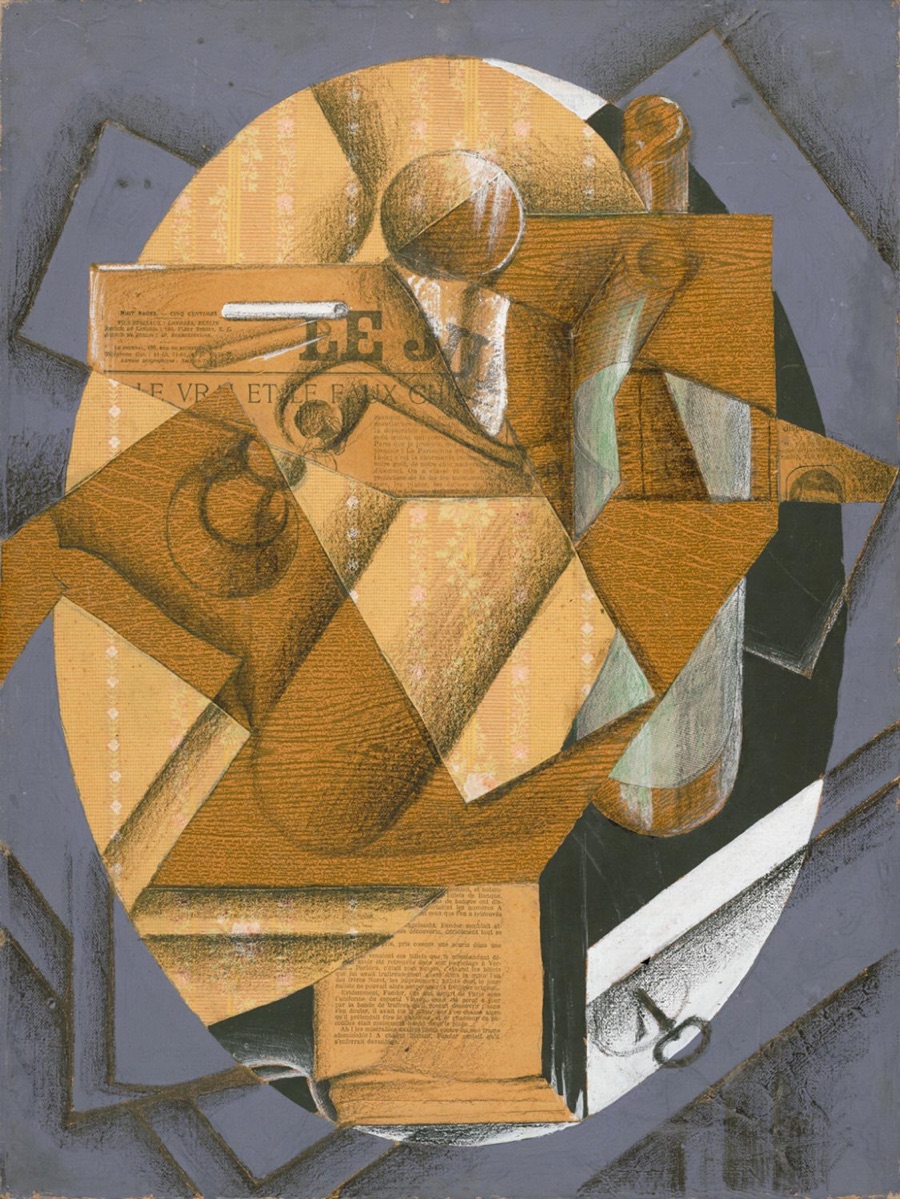
At first glance, The Table by Juan Gris looks like a still life that has been taken apart and reassembled by someone with a very precise mind. A tabletop tilts toward you. Fragments of newspaper, sheet music, and the curve of a guitar slide over one another like cards fanned across a table. Nothing sits where perspective says it should, and yet the whole thing feels calm, balanced, almost inevitable. Made in 1914 and now held by the Philadelphia Museum of Art, it is one of the clearest windows into what Cubism was actually trying to do.
The Spaniard in Picasso's Building
Juan Gris was not born Juan Gris. His real name was Jose Victoriano Gonzalez-Perez, and he was born in Madrid. As a young man he moved to Paris, where he took a studio in the Bateau-Lavoir, the famous ramshackle building in Montmartre where Pablo Picasso also lived and worked. That address put him at the center of the most radical artistic experiment of the century. While Picasso and Georges Braque were inventing Cubism a few doors away, Gris was watching, absorbing, and quietly preparing his own version of it.
He is often called the third great Cubist, after Picasso and Braque. But he was never a mere follower. Where the other two worked by instinct and improvisation, Gris was the most systematic of the three. He approached a picture the way an architect approaches a building, with structure decided first and details fitted in afterward. That discipline gives his work a clarity that stands apart from the rest of the movement.
A Picture Made of Paper and Charcoal
The Table is not a conventional painting. It is a papier colle, a collage built from pieces of pasted paper combined with charcoal drawing. Some of the paper is printed. Gris included actual newspaper, so a fragment of the everyday world sits directly on the surface of the artwork, not depicted but physically present.
This changes how you look at it. In a traditional still life, everything is illusion: painted wood pretends to be a table, painted paper pretends to be a letter. In The Table, real paper plays the role of paper, and drawn lines carry the rest. The boundary between the object and its image starts to blur, and Gris seems to enjoy the confusion. The work asks a sly question: if a picture of a newspaper can be made from a newspaper, what exactly is a picture?
Synthetic Cubism, Explained Simply
The Table belongs to the phase art historians call Synthetic Cubism. The earlier phase, Analytic Cubism, broke objects down. Painters shattered a violin or a face into small facets, examined it from many angles at once, and rendered it in muted browns and grays. The results were fascinating but often nearly unreadable.
Synthetic Cubism reversed the process. Instead of breaking things down, artists built images up from flat, simple shapes. A curved plane becomes a guitar. A rectangle of printed paper becomes a newspaper on a table. The shapes are larger, the colors clearer, the compositions easier to read. Gris constructs this still life the way a composer builds a piece of music, with overlapping planes, rhythmic shapes, and carefully calibrated tones. The guitar, the sheet music, and the tabletop coexist in a reality reshaped by intellect rather than direct observation.
How Collage Changed What a Picture Could Be
It is hard to overstate what collage did to Western art. For centuries, a picture was a window: you looked through the surface into an imagined space. When the Cubists began gluing paper onto their work, they broke that window for good. The surface itself became the subject. Materials from ordinary life, newsprint and wallpaper and printed labels, could now enter art directly.
Almost everything that followed owes something to that move. Assemblage, photomontage, and a great deal of contemporary art all trace back to those few years before the First World War when Picasso, Braque, and Gris started cutting and pasting. Gris brought his usual elegance to the technique. In The Table, nothing feels random. Every fragment is placed with the care of someone solving an equation, and the finished work is proof of his commitment to clarity within fragmentation.
A Puzzle of a Picture That Is Already a Puzzle
There is a pleasing irony in turning The Table into a jigsaw puzzle. Gris made the work by cutting materials into fragments and fitting them into a whole. A jigsaw does exactly the same thing, only in reverse and then forward again. You scatter the image, then rebuild it piece by piece, following the same edges and planes that Gris drew and pasted more than a century ago.
Cubist collage happens to make wonderful puzzle material. The overlapping shapes, the shifts in texture between charcoal and newsprint, and the strong internal geometry give you real landmarks to navigate by. Each piece you place teaches you a little about how the composition locks together. You can try it yourself: The Table is included in Artizen's free Art Lovers collection, so you can reassemble Gris's still life on your own screen and feel, in a small way, how deliberately it was built. Artizen is free to download on the App Store.
Gris died young, at 40, but his cool, methodical Cubism never stopped influencing painters. The Table shows him at the height of that quiet power, holding fragments together with nothing but intelligence and glue.
More stories from the collection: read about the portrait of Josette Gris and the Mona Lisa, or browse all 12 painting stories.

