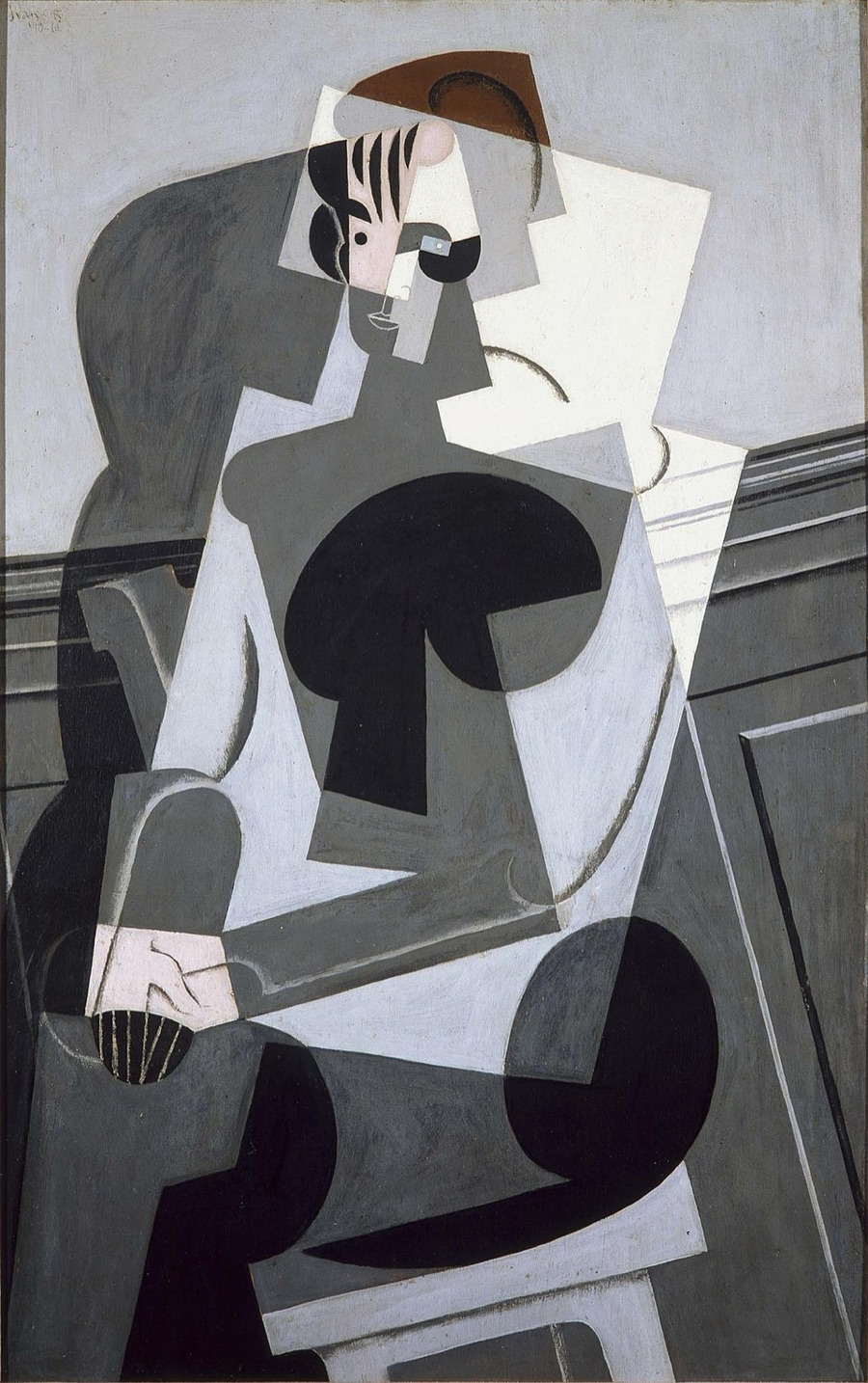
At first glance, the Portrait of Josette Gris looks like a puzzle someone has already started solving. A woman sits with her hands folded, her face and body assembled from crisp planes of muted color. Look longer and the geometry softens. You start to see a real person: calm, patient, present. Juan Gris painted her in 1916, in the middle of a world war, and somehow produced one of the most quietly affectionate portraits in all of Cubism.
The Woman Behind the Facets
Josette was Juan Gris' lifelong companion. They met in Paris in the years before the war and stayed together until his death in 1927, when he was only forty. She ran his household through lean years, sat for him, and appears in his correspondence as a constant, steadying presence. When Gris painted her, he was not painting a hired model or an abstract idea of a woman. He was painting the person across the table.
That intimacy matters. Cubism has a reputation for being cold and cerebral, all theory and no heart. This portrait argues otherwise. The pose is composed and dignified, the hands resting quietly, the whole figure carrying the stillness of someone completely at ease with the man looking at her.
Can a Cubist Portrait Be Tender?
Here is the challenge Gris set himself. Cubism breaks its subject into fragments, and fragmenting a person you love risks turning them into a diagram. Gris solved it through color and rhythm. The palette is soft: grays, muted blues, warm earth tones that hold together in gentle harmonies rather than clashing. The planes do not shatter Josette so much as fold around her, like light moving across a room over the course of an afternoon.
The result is a painting that feels both rigorous and warm. Critics often describe Gris' work from this era as his Crystal period, when his compositions grew more refined and architectural. The name fits. A crystal is geometric, but it also catches the light.
Building a Face from Geometry
What is remarkable is how much likeness survives the abstraction. Gris keeps the essential landmarks: the oval of the face, the line of the nose, the dark sweep of hair. Then he lets the facets do their work, shifting planes of tone that suggest the head turning slightly, the way you remember a face rather than the way a camera freezes it.
The abstraction does not erase her presence. It heightens it. Because you cannot take the image in at a single glance, you keep looking, and the longer you look the more human she becomes. Gris understood that a portrait is not a record of features but a record of attention, and this painting is attention made visible.
Painted in the Shadow of War
The date tells its own story. In 1916 Europe was two years into the First World War. Gris, a Spaniard, was not called to fight, and he remained in France while many of his friends went to the front. The war years were hard for him. The Paris art market had collapsed, money was scarce, and he worked through the uncertainty with a discipline that shows in the canvases of this period.
Seen against that backdrop, the portrait's calm feels almost defiant. While the world outside was chaos, Gris built something ordered, balanced, and full of quiet feeling. It is hard not to read the painting as a small act of devotion, both to Josette and to the idea that art could still hold things together.
Not Picasso's Kind of Portrait
Comparisons with Picasso are unavoidable. Both were Spaniards in Paris, both central to Cubism, and Picasso's portraits from his Cubist years often pull faces apart with restless, aggressive energy. Gris worked differently. Where Picasso improvised, Gris composed. He planned his paintings with an architect's care, and his portraits feel measured rather than explosive.
Neither approach is better, but they reveal different temperaments. Picasso's Cubism confronts you. Gris' Cubism invites you in, asks you to sit down, and rewards patience. The Portrait of Josette Gris may be the clearest example of that invitation anywhere in his work. Today the painting hangs in the Museo Reina Sofia in Madrid, the great museum of modern Spanish art, where it shares a home with Picasso's Guernica. Two Spanish visions of the modern world, a few rooms apart.
A Painting That Was Already a Puzzle
There is a nice irony in solving this portrait as a jigsaw puzzle. Gris already did the cutting for you. Cubism breaks its subject into interlocking pieces, so reassembling Josette facet by facet feels less like a game and more like retracing the artist's own process. You learn the painting from the inside: which gray belongs to her cheek, which plane is shadow and which is hair. Piece by piece, the logic of the composition reveals itself in a way that simply looking never quite manages.
You can try it yourself. The Portrait of Josette Gris is included in Artizen's free Art Lovers collection, reproduced in crisp detail and playable at difficulty levels from a quick session to a genuine challenge. Artizen is free to download on the App Store, and Josette is waiting, composed as ever.
More stories from the collection: read about the Mona Lisa and The Starry Night, or browse all 12 painting stories.

