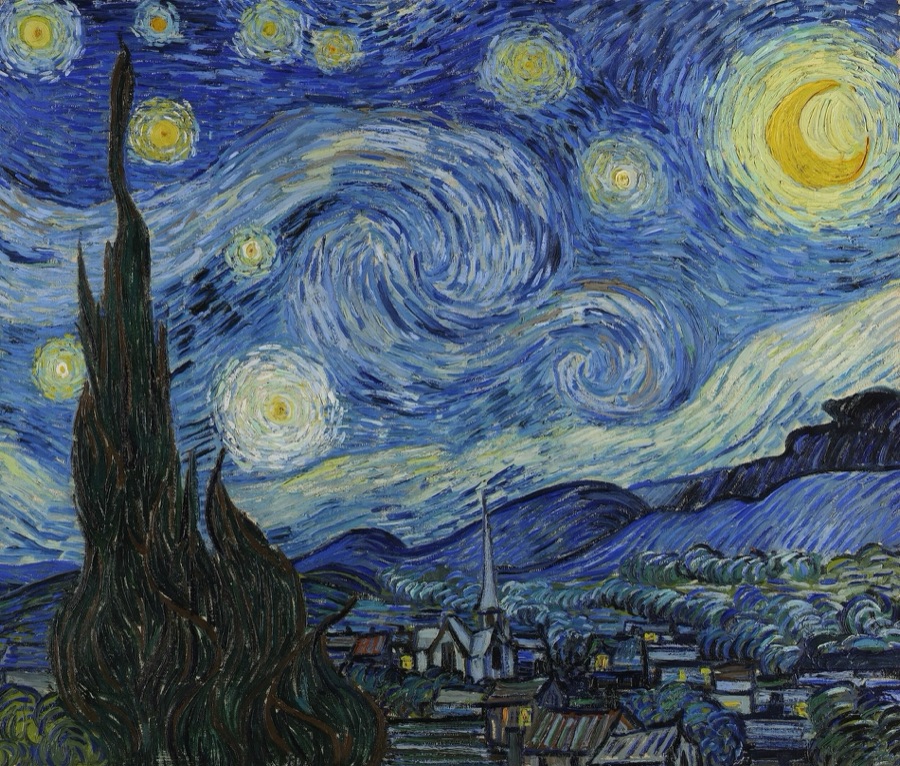
The Starry Night might be the most reproduced painting on earth. It hangs on dorm room walls, phone cases, and coffee mugs, and somewhere along the way it became so familiar that we stopped really looking at it. That is a shame, because the story behind those swirling blues is stranger and more moving than most people realize. Vincent van Gogh painted it in June 1889, and almost nothing about how it came to be matches what you would guess.
It Was Painted Inside an Asylum
In May 1889, Van Gogh committed himself to the Saint-Paul-de-Mausole asylum in Saint-Remy-de-Provence, in the south of France. He had suffered a severe breakdown in Arles a few months earlier, and he arrived at the asylum exhausted and frightened by his own mind. Yet the year he spent there became one of the most productive of his life. He was given a small bedroom with a barred window facing east, and the view from that window, over a wheat field toward distant hills, became his obsession. The Starry Night grew out of that view.
He Painted the Night Sky in Broad Daylight
Here is the detail that surprises almost everyone. Van Gogh was not allowed to paint in his bedroom, so The Starry Night was made in a studio on the ground floor, during the day, from memory and from sketches. He had watched the sky before sunrise through his window many times and described it in letters to his brother Theo. But when he stood at the easel, the night existed only in his head. That is partly why the painting feels the way it does. It is less a view from a window than a vision, an inner landscape shaped by memory, longing, and imagination.
The village below the hills is invented too. No village was visible from his window, and the slender church spire looks more like the churches of his native Netherlands than anything in Provence. He was painting homesickness as much as he was painting stars.
The Brightest Star Is Not a Star
Look just to the right of the cypress tree, at the large white glow low in the sky. That is Venus. Van Gogh wrote to Theo that he had seen the morning star from his window before dawn, looking very big, and astronomers have since confirmed that Venus was unusually bright in the pre-dawn sky over Provence in June 1889. So the most dramatic light in this dreamlike sky is also its most accurate one. The crescent moon and eleven stars around it burn with halos no telescope would show, but Venus is right where it should be.
The Cypress Is Doing More Than Decorating
The dark shape rising up the left side of the canvas is a cypress, a tree that Van Gogh loved and painted again and again during his year in Saint-Remy. He once wrote that cypresses were as beautiful in line and proportion as an Egyptian obelisk. In Mediterranean tradition the cypress is a graveyard tree, planted beside tombs, a quiet symbol of mourning. In the painting it rises like a dark flame, the only thing on the ground tall enough to touch the sky. Many viewers read it as a bridge between the earth and whatever lies beyond it. Whether Van Gogh intended that or simply loved its shape, it turns a pretty landscape into something that feels like a question.
Van Gogh Was Not Sure It Was Any Good
The painting that now anchors the Museum of Modern Art in New York did not impress its own maker. In his letters, Van Gogh was hard on the works he had painted from imagination rather than from direct observation, and he mentioned this canvas without much enthusiasm. It sold to no one during his lifetime. Only in the twentieth century did the painting begin its climb, and when MoMA acquired it in 1941 it settled into the role it has held ever since, as shorthand for what art can do with a difficult night. There is something consoling in that gap between what he felt about it and what it became.
Why a Puzzle Makes You Finally See It
Most of us have looked at The Starry Night hundreds of times without ever seeing it slowly. Solving it as a jigsaw puzzle changes that completely. When you are holding a single piece of that sky, hunting for where one swirl curls into the next, you start to notice how the strokes actually move, how the blues shift from almost black to nearly green, how the halo around Venus is built from rings of separate touches of paint. The cypress stops being a silhouette and becomes a tangle of writhing brushwork. You spend twenty minutes inside the painting instead of two seconds in front of it.
If you want to try it, The Starry Night is included in the free Art Lovers collection in Artizen, an art jigsaw puzzle app for iPhone and iPad. The reproduction is sharp enough that every swirl survives being cut into pieces, and putting the sky back together, star by star, is about the closest most of us will get to watching Van Gogh build it in the first place.
More stories from the collection: read about The Scream and Rembrandt's stolen seascape, or browse all 12 painting stories.

