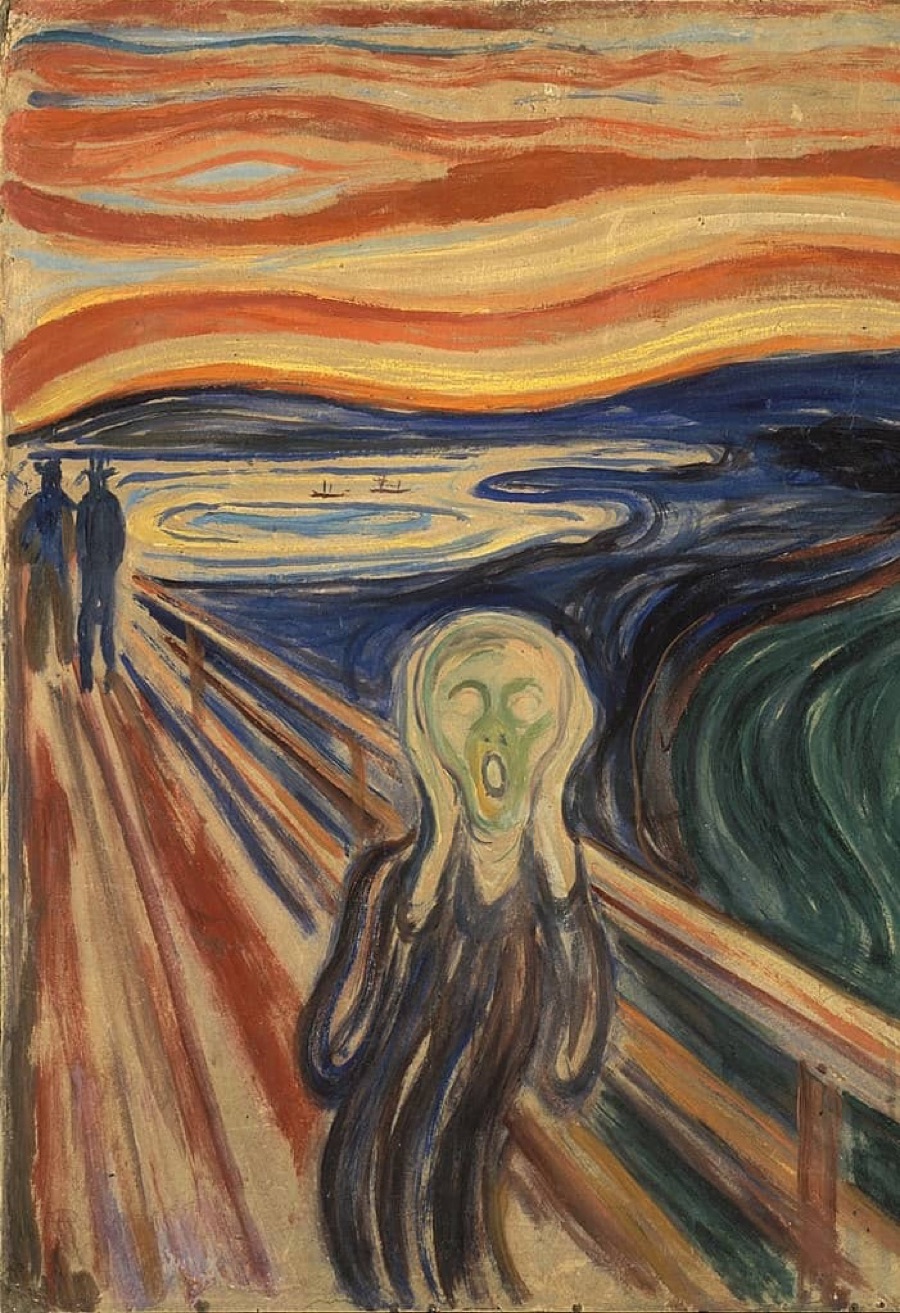
Edvard Munch painted The Scream in 1893, and it has since become shorthand for anxiety itself. The bald figure on the bridge, the mouth stretched into an oval, the sky burning in bands of red and orange. It appears on mugs, in emoji keyboards, in horror movie posters. Yet for a painting this famous, most people know surprisingly little about it, and some of what they think they know is simply wrong. The Scream painting has been stolen twice, hides a secret insult in pencil, and depicts something quite different from what its title suggests.
There Is More Than One Scream
Munch did not paint The Scream once. He returned to the image again and again, producing two painted versions, two pastels, and a lithograph that let the composition spread across Europe in print form. The famous 1893 painting, made with oil, tempera, and pastel on cardboard, hangs in the National Gallery in Oslo. A later painted version belongs to the Munch Museum in the same city. One of the pastels, from 1895, is the only version in private hands. When it came up for auction at Sotheby's in 2012, it sold for nearly 120 million dollars, at the time the highest price ever paid for an artwork at auction.
The Figure Is Not Actually Screaming
Look closely and you will notice the figure's hands are not raised in a shout. They are pressed against the sides of the head, covering the ears. Munch explained why in a diary entry describing the experience behind the picture. He was walking with two friends at sunset when the sky suddenly turned blood red. He stopped, leaned against the fence, trembling with anxiety, and sensed what he called an infinite scream passing through nature. The figure is not producing the scream. It is hearing it, and trying desperately to shut it out. That reversal changes the whole painting. The horror is not inside one person. It is everywhere, soaked into the landscape itself.
The Blood-Red Sky Might Be Real
Those swirling bands of red have long been read as pure expression, the sky bent to match Munch's inner state. But some researchers think he painted something he genuinely saw. In 1883 the volcano Krakatoa erupted in Indonesia, throwing so much ash into the atmosphere that sunsets across Europe glowed a lurid red for months afterward. Astronomers from Texas State University argued in 2004 that Munch witnessed these volcanic skies over Oslo and remembered them years later. Other scientists have proposed a different culprit: nacreous clouds, a rare wavy formation seen in Norwegian winters that shimmers in exactly those colors. The debate is unresolved, which is somehow fitting. Even the sky in this painting refuses to sit still.
Stolen Twice, Recovered Twice
Few paintings have had a rougher time in the twentieth and twenty-first centuries. In February 1994, on the opening day of the Winter Olympics in Lillehammer, thieves climbed a ladder into the National Gallery and walked out with the 1893 version. They left a note thanking the museum for its poor security. The painting was recovered undamaged a few months later. Then in August 2004, armed robbers entered the Munch Museum in broad daylight and tore its version of The Scream off the wall, along with Munch's Madonna, while visitors watched. Both works were recovered in 2006, and after conservation they went back on display.
A Hidden Sentence in Pencil
In the upper left corner of the 1893 painting there is a tiny inscription, barely visible, written in pencil: "Can only have been painted by a madman." For decades no one knew who wrote it. Was it a vandal? An outraged early viewer? In 2021, the National Museum of Norway used infrared scanning to study the handwriting and concluded that it belonged to Munch himself. He likely added the line after hearing his sanity questioned at an early showing of the work. It reads less like a confession than a wry answer to his critics, hiding in plain sight for over a century.
What You Notice When You Solve It Piece by Piece
Here is the strange thing about very famous paintings. We stop seeing them. The Scream is so familiar that the eye slides right over it. Solving it as a jigsaw puzzle undoes that. When you are hunting for the piece that completes the railing, you finally register the two figures walking away in the background, the friends from Munch's diary who kept going while he stood frozen. When you sort the sky pieces, you see that the red is not one color at all but layered ribbons of orange, yellow, and near-purple, each band pulling in a slightly different direction. The fjord turns out to be full of deep blues you never noticed. The Scream is included in Artizen's free Art Lovers collection, so you can take it apart and put it back together yourself, no purchase needed. It is a slower way to look at a painting about a single overwhelming moment, and the contrast is part of the pleasure.
Munch made an image of panic that rewards patience. Give it twenty quiet minutes and it gives you back details the postcards never show. If you want to try it, Artizen is free to download on the App Store.
More stories from the collection: read about Rembrandt's stolen seascape and Café Terrace at Night, or browse all 12 painting stories.

