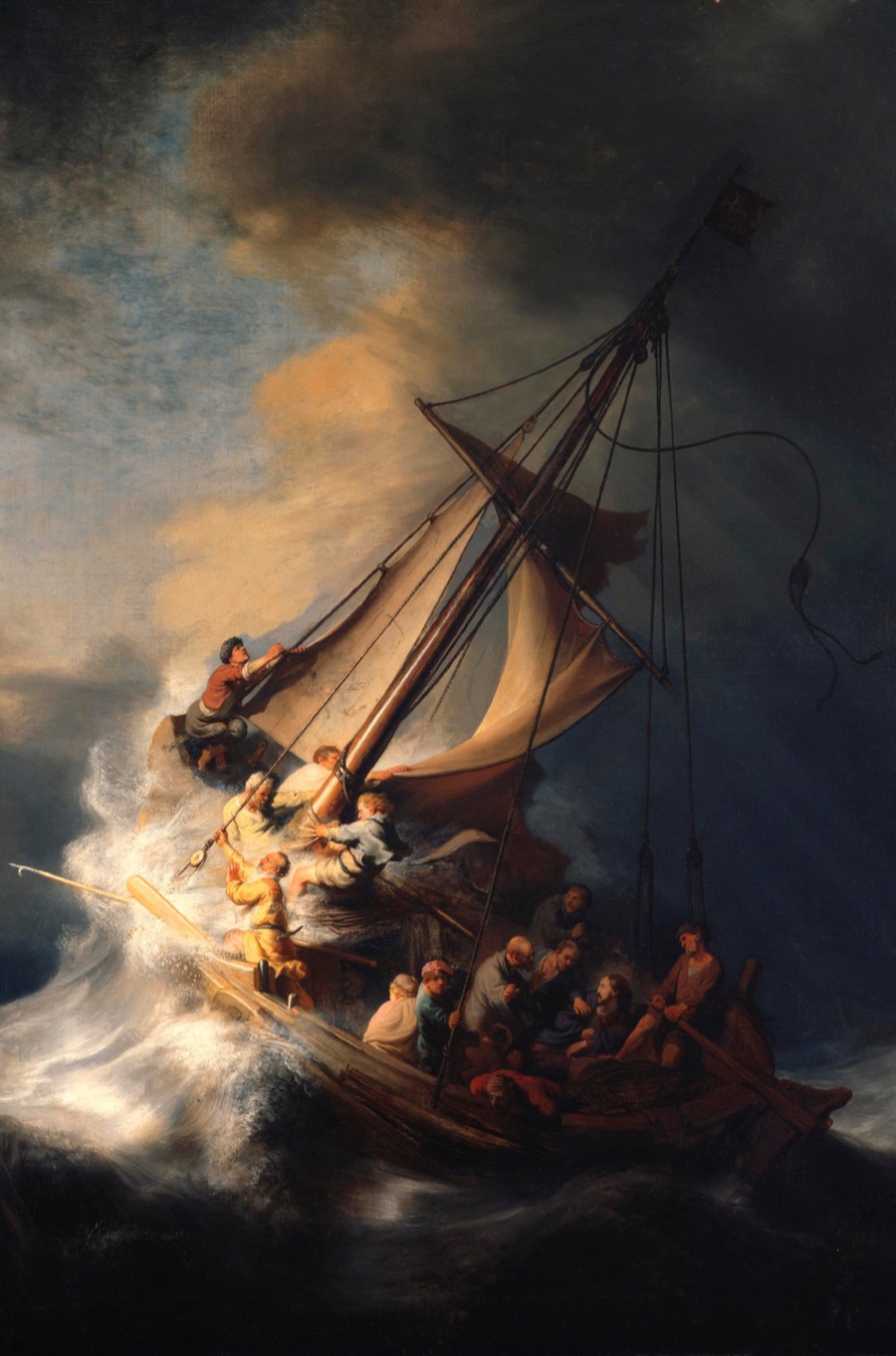
In 1633, a 27-year-old Rembrandt painted a boat full of terrified men caught in a violent storm. Waves crash against the hull, the mast strains toward collapse, and one figure vomits over the side while Christ sits calmly in the stern. It is one of the most dramatic paintings the Dutch master ever produced. And for more than three decades, no one has been able to see it. Christ in the Storm on the Sea of Galilee was stolen in 1990 and has never been recovered. The story of this painting is stranger than most fiction.
Rembrandt's Only Seascape
Rembrandt painted portraits, biblical scenes, landscapes, and some of the most searching self-portraits in the history of art. But as far as anyone knows, he painted the open sea exactly once. Christ in the Storm on the Sea of Galilee is his only known seascape, which makes its disappearance sting even more. The scene comes from the Gospel of Mark, where Jesus and his disciples are crossing the Sea of Galilee when a storm nearly swamps their boat. The panicked disciples wake him, and he calms the wind and water with a word.
Rembrandt splits the canvas between chaos and calm. On the left, a shaft of light breaks through the clouds and catches the wave smashing over the bow, where the crew fights the rigging. On the right, in shadow, Christ is being shaken awake by desperate men. The light is not a rescue. It is a revelation, showing the violence of the storm and the composure at its center in the same glance.
Count the Figures in the Boat
Here is the detail that makes people lean in. The Gospel story involves Jesus and his twelve disciples, thirteen men in total. Rembrandt painted fourteen. The extra figure grips a rope with one hand and holds onto his cap with the other, and instead of fighting the storm or pleading with Christ, he looks directly out of the painting at you.
That face is widely recognized as Rembrandt himself. He put himself in the boat, mid-catastrophe, meeting the viewer's gaze. It is a bold move for a young painter. He was not content to illustrate the miracle from a safe distance; he pulled himself, and by extension everyone who looks at the picture, into the crisis. You are not watching the storm. You are in it.
The Night It Vanished
In the early hours of March 18, 1990, two men dressed as police officers talked their way into the Isabella Stewart Gardner Museum in Boston. They tied up the two security guards on duty and spent the next hour and a half cutting and pulling thirteen works from the collection. Along with the Rembrandt, they took Vermeer's The Concert, one of only about three dozen Vermeer paintings in existence, plus works by Degas and Manet.
The haul has been valued at hundreds of millions of dollars, making it the largest unsolved art theft in United States history. Despite decades of FBI investigation, tips from around the world, and endless theories involving organized crime, none of the thirteen works has ever been recovered. The case remains open.
The Empty Frame Still Hangs
Isabella Stewart Gardner left strict instructions in her will: her collection was to remain exactly as she arranged it, nothing added, nothing removed. The museum has honored that wish in the most haunting way possible. The frames that once held the stolen paintings still hang on the walls, empty. Visitors to the Dutch Room stand in front of the gilded frame where Christ in the Storm on the Sea of Galilee used to be and look at bare fabric.
The museum has not given up. It offers a $10 million reward for information leading to the recovery of the stolen works, one of the largest rewards ever attached to stolen art. Somewhere, presumably, Rembrandt's storm is still raging in a crate or a basement or behind a false wall, waiting.
Study Every Figure Yourself, Piece by Piece
Since no one can stand in front of the real canvas anymore, the closest most of us will get is a high-resolution reproduction. And there is a case to be made that solving this painting as a jigsaw puzzle is one of the best ways to actually see it. A puzzle forces you to slow down and study every figure in the boat: the man wrestling the sail, the one clutching the tiller, the one leaning over the side in misery, the huddle around Christ in the stern. Assemble it piece by piece and you will inevitably find yourself hunting for the fourteenth man. Can you spot Rembrandt looking back at you?
Christ in the Storm on the Sea of Galilee is included in Artizen's free Art Lovers collection, so you can spend real, unhurried time with a painting that nobody can visit in person anymore. It is a small way of keeping a lost masterpiece in view. Artizen is free to download on the App Store.
A Painting Worth Remembering
Every stolen artwork leaves a hole, but this one feels particularly cruel. Rembrandt's single seascape, with his own face hidden among the apostles, reduced to an empty frame in a Boston museum. Until the day it resurfaces, the best thing art lovers can do is keep looking at it, keep talking about it, and keep the storm alive in memory. The reward still stands. So does the frame.
More stories from the collection: read about Café Terrace at Night and Matisse's Open Window, or browse all 12 painting stories.

