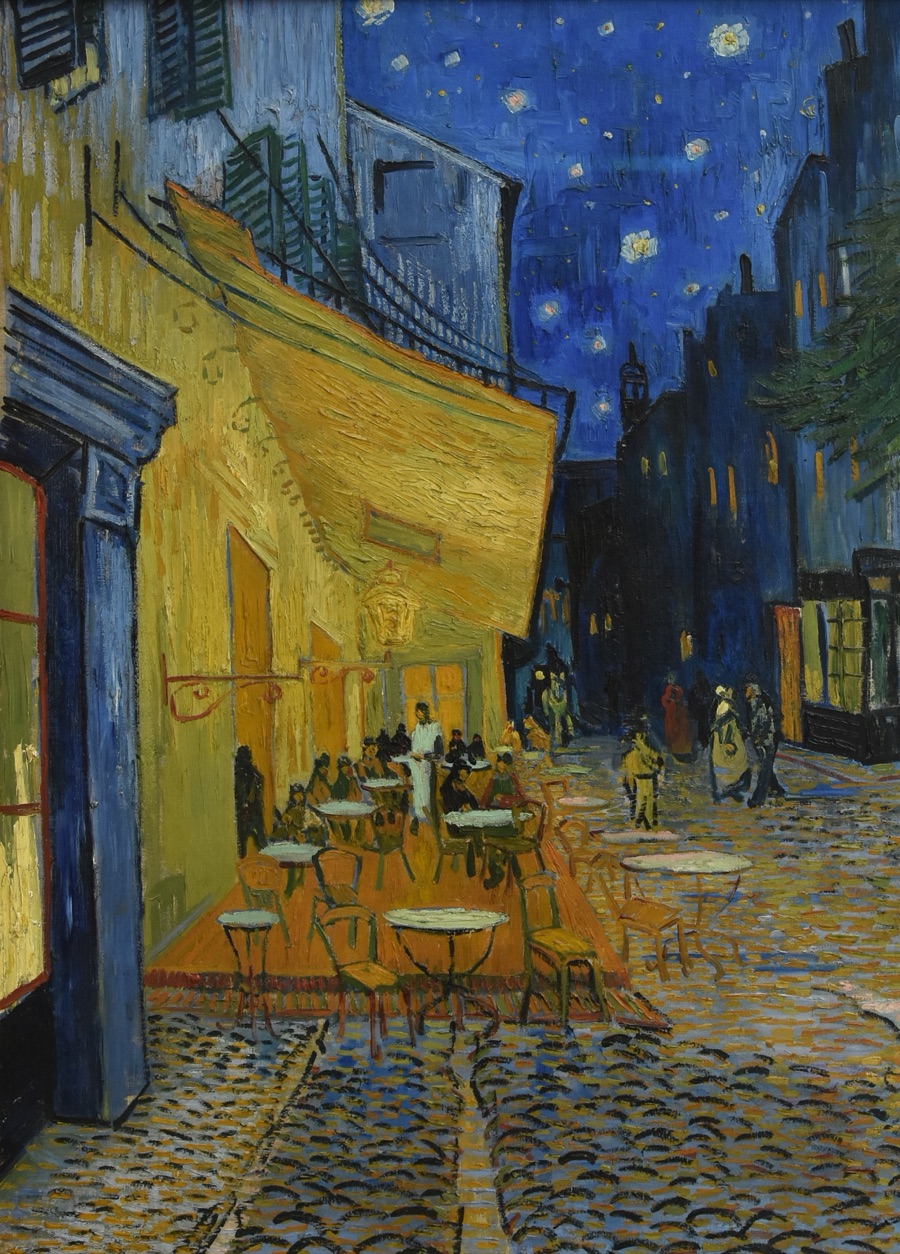
In September 1888, Vincent van Gogh set up his easel on a street corner in Arles, in the south of France, and painted a café glowing against the evening sky. The result is one of the most loved images in Western art. The lamplight pools onto the cobblestones like liquid warmth, the terrace hums with late diners, and above it all the night opens into a calm dome of deep blue scattered with stars. Behind that familiar scene sit some genuinely surprising Cafe Terrace at Night facts, and they make the painting even better once you know them.
His First Starry Sky
Everyone knows The Starry Night, the swirling masterpiece Van Gogh painted in 1889. Fewer people realize that Café Terrace at Night came first. This canvas, painted in early September 1888, is one of the first times he ever attempted a starry sky in oil paint. Later that same month he painted Starry Night Over the Rhône, and the famous Starry Night followed the next June, after he had entered the asylum at Saint-Rémy.
So the modest café terrace is where the obsession began. Van Gogh had written about his longing to paint the night, and here he finally did it. The stars are simple dabs of pale paint, almost like flowers opening in the dark, but you can already feel where his imagination was heading.
Painted Outside, in the Dark
Van Gogh did not paint this scene from memory in a studio. He worked on location, at night, standing on the Place du Forum while the café behind him did its evening business. Painting outdoors was normal for the Impressionists, but painting outdoors after sunset was something else entirely. He worked by the glow of the café's gas lamps, judging his colors in the very light he was trying to capture.
It was a strange sight for the locals, a red-haired Dutchman squinting at a canvas in the dark. But the method explains the painting's honesty. The exaggerated warmth of the terrace and the way the shadows fall come from direct observation, not invention. He was standing right there.
A Night Scene With No Black
Here is the fact that changes how you see the painting: there is no black in it. Not in the sky, not in the shadows, not anywhere. Van Gogh built the entire night out of blues, violets, greens, and the fierce citron yellow of the awning. He wrote to his sister Willemien about the picture, telling her that he found it enormously interesting to paint the night on the spot, and that the night was more alive and more richly colored than the day.
The idea sounds simple until you try to pull it off. Darkness in this painting is not an absence. It is a color in its own right, and the glow of the café only works because the blue around it is so deep and so saturated. He was not aiming for strict realism. The perspective tilts slightly, the colors heighten, and the whole scene feels charged with quiet anticipation, as if the terrace were a doorway into the new rhythms of evening life.
You Can Still Have Coffee There
The café Van Gogh painted was a real business on the Place du Forum in Arles, and the building still stands on that same square today. For years it operated as a café trading on the connection, its facade painted yellow to echo the canvas. Visitors to Arles can walk to the exact corner, stand roughly where Van Gogh planted his easel, and compare the painting to the place. The square is smaller than the picture suggests, which tells you something about how much feeling he poured into it.
He Never Signed It
Look closely at the canvas and you will find no signature. Van Gogh never signed Café Terrace at Night. There is no doubt about who painted it, though, because he described the picture in detail in his letters, including the one to his sister. Those letters serve as a kind of signature in prose, and they give us something rarer than a name in the corner: the artist's own excitement, written down while the paint was still fresh. The painting now hangs in the Kröller-Müller Museum in Otterlo, in the Netherlands.
Seeing the Light, Piece by Piece
There is a particular pleasure in solving this painting as a jigsaw puzzle. When you sort the pieces, you are essentially taking Van Gogh's color logic apart and putting it back together. You hold a fragment of pure orange next to a fragment of deep blue and watch them ignite each other, exactly the contrast he used to make gaslight glow without a single stroke of black. The starry sky pieces, all subtle shifts of blue on blue, are the quiet challenge at the heart of it.
If you want to try it, Café Terrace at Night is included in Artizen's free Art Lovers collection, alongside other favorites from the history of art. The app is free to download on the App Store, and the reproduction is sharp enough that you will notice brushstrokes you have never seen before. It is a slow, satisfying way to understand why a quiet café in Arles became one of the most famous nights ever painted.
More stories from the collection: read about Matisse's Open Window and Hokusai's waterfalls, or browse all 12 painting stories.

