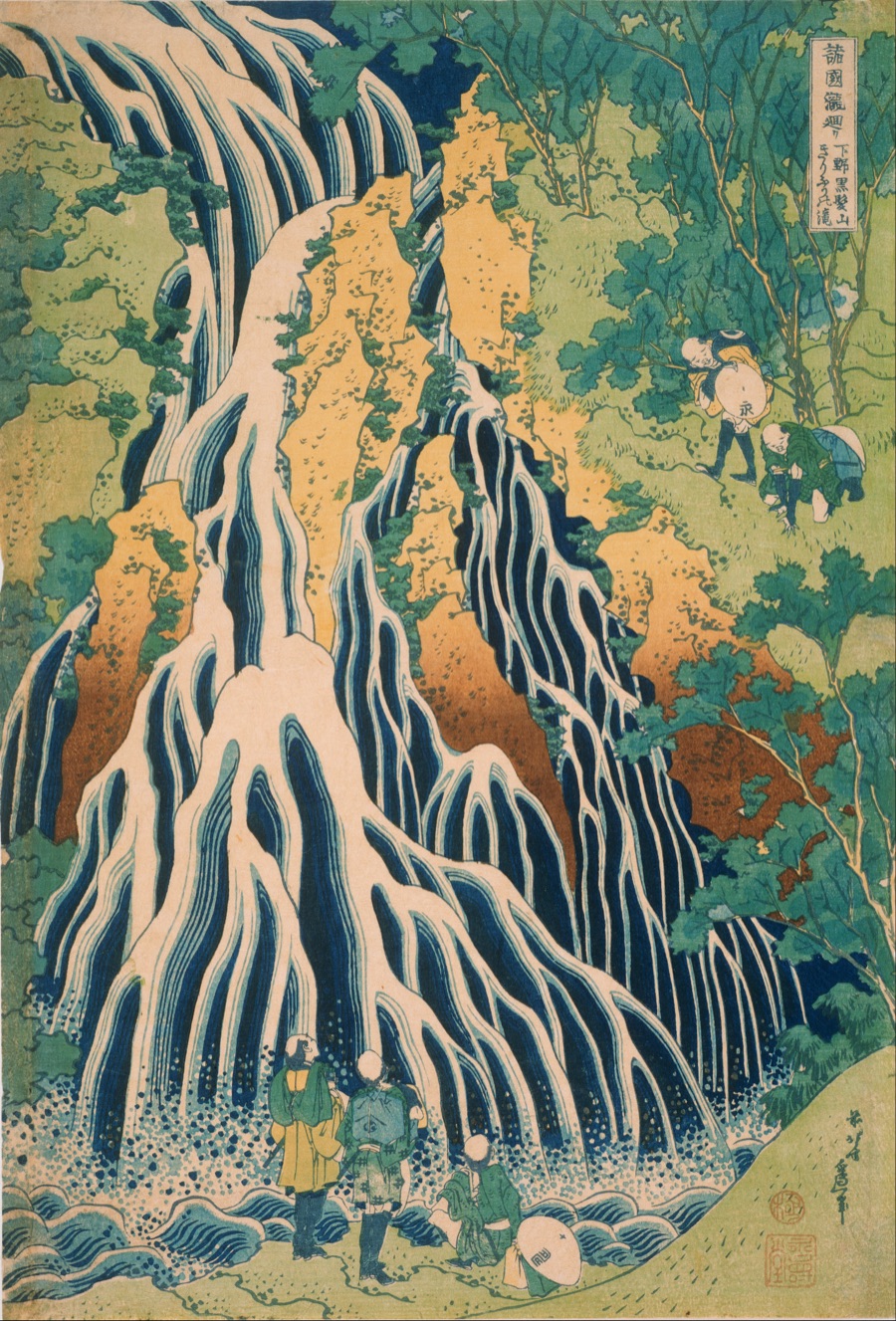
Look at any print from A Tour of the Waterfalls of the Provinces and the first thing you notice is that the water does not behave like water. It hangs in ribbons. It splits into strands that look like roots, or veins, or hair. Katsushika Hokusai made this series around 1833, and in it he treated waterfalls as characters, not scenery. The tiny travelers crossing bridges beneath them are dwarfed, almost incidental, brief visitors in a landscape shaped over thousands of years.
Eight Waterfalls, One Restless Mind
The series consists of eight woodblock prints, each depicting a famous waterfall in a different region of Japan. Some of the falls were pilgrimage sites, places people traveled long distances to see and to pray beside, and Hokusai gave each one its own personality. One waterfall plunges in a single thundering column. Another fans out across a cliff face in dozens of delicate threads. The most famous of the group, the Amida Falls, opens at the top into a huge round basin that resembles a staring eye. It is a strange, almost supernatural image, and it makes the point of the whole series. These prints treat waterfalls almost like sacred beings, reminding viewers that nature is not merely scenic but a force that humbles and protects at once.
An Old Man at the Height of His Powers
Hokusai was in his seventies when he made these prints. He had just finished Thirty-six Views of Mount Fuji, the series that includes The Great Wave off Kanagawa, and instead of resting on that success he pushed further. The Fuji series had made bold use of Prussian blue, a vivid imported pigment that was relatively new to Japanese printmaking, and the waterfall series continues that love affair. Deep blues pour down every sheet. Where the wave had shown water as violence, the waterfalls show it as something older and calmer: patient, permanent, endlessly falling.
How a Woodblock Print Was Actually Made
It helps to remember that Hokusai never touched most of the objects we now call his prints. Ukiyo-e was a collaborative craft. The artist supplied the drawing. A block carver then cut that design into cherry wood, one block for the outlines and separate blocks for each color. A printer inked the blocks and pressed them onto paper by hand, sheet after sheet, keeping every layer in perfect register. A publisher financed and sold the results. The crisp lines and flat, saturated colors that make Hokusai's waterfalls so striking are partly the signature of this process. Every curve of falling water had to be carved into wood before it could exist on paper, which is one reason the water looks so graphic and so deliberate.
Water as a Living Force
Hokusai returned to water throughout his long career. Waves, rivers, rain, whirlpools, and waterfalls appear again and again in his work, and he never drew them the same way twice. In this series the water plunges in stylized sheets and arcs that echo the curves of the mountains and trees cradling each fall, as if landscape and cascade were parts of one organism. Great waterfalls in Japan had long been associated with purification and the divine, and Hokusai leaned into that tradition. His falls feel less like geology and more like presences. You half expect them to breathe.
The Old Man Crazy About Painting
Late in life Hokusai signed his work Gakyo Rojin, the old man crazy about painting. In a famous postscript written in his mid seventies, he claimed that nothing he had drawn before seventy was worth counting, that at seventy-three he had finally begun to grasp the structure of birds, animals, and plants, and that if he lived to one hundred and ten, every dot and every line would be alive. He died in 1849 at eighty-nine, reportedly still wishing for a few more years to become a true artist. The waterfall series is what that hunger looked like in practice: a man past seventy inventing new ways to draw falling water.
The Ripple That Reached Paris
Decades after Hokusai's death, Japanese prints began circulating in Europe, and they landed like a revelation. Painters including Monet, Degas, and van Gogh collected ukiyo-e and absorbed its lessons: flattened space, bold cropping, everyday subjects, and outlines that carry real expressive weight. Monet filled his home at Giverny with Japanese prints. Van Gogh copied them outright in oil. This wave of influence, which the French called Japonisme, helped loosen European painting from strict perspective and shaded realism. The Impressionists saw the world a little differently because an old man in Edo had spent his life drawing water.
Seeing the Waterfall Piece by Piece
There is a particular pleasure in solving one of these prints as a jigsaw puzzle. Hokusai's line work is so graphic that every piece reads like a small abstract drawing: a curve of blue, a knot of rock, a fragment of pine. Then you place a piece and suddenly notice the travelers, tiny figures with walking sticks and packs, crossing a bridge under a wall of falling water that could swallow them whole. The scale of the image only really registers when you have assembled it with your own hands. A Tour of the Waterfalls of the Provinces is included in Artizen's free Art Lovers collection, so you can piece together Hokusai's waterfall on your iPhone or iPad without paying anything. Artizen is free to download on the App Store, and the waterfall is waiting.
More stories from the collection: read about Klimt's Pear Tree and Renoir's Julie Manet, or browse all 12 painting stories.

