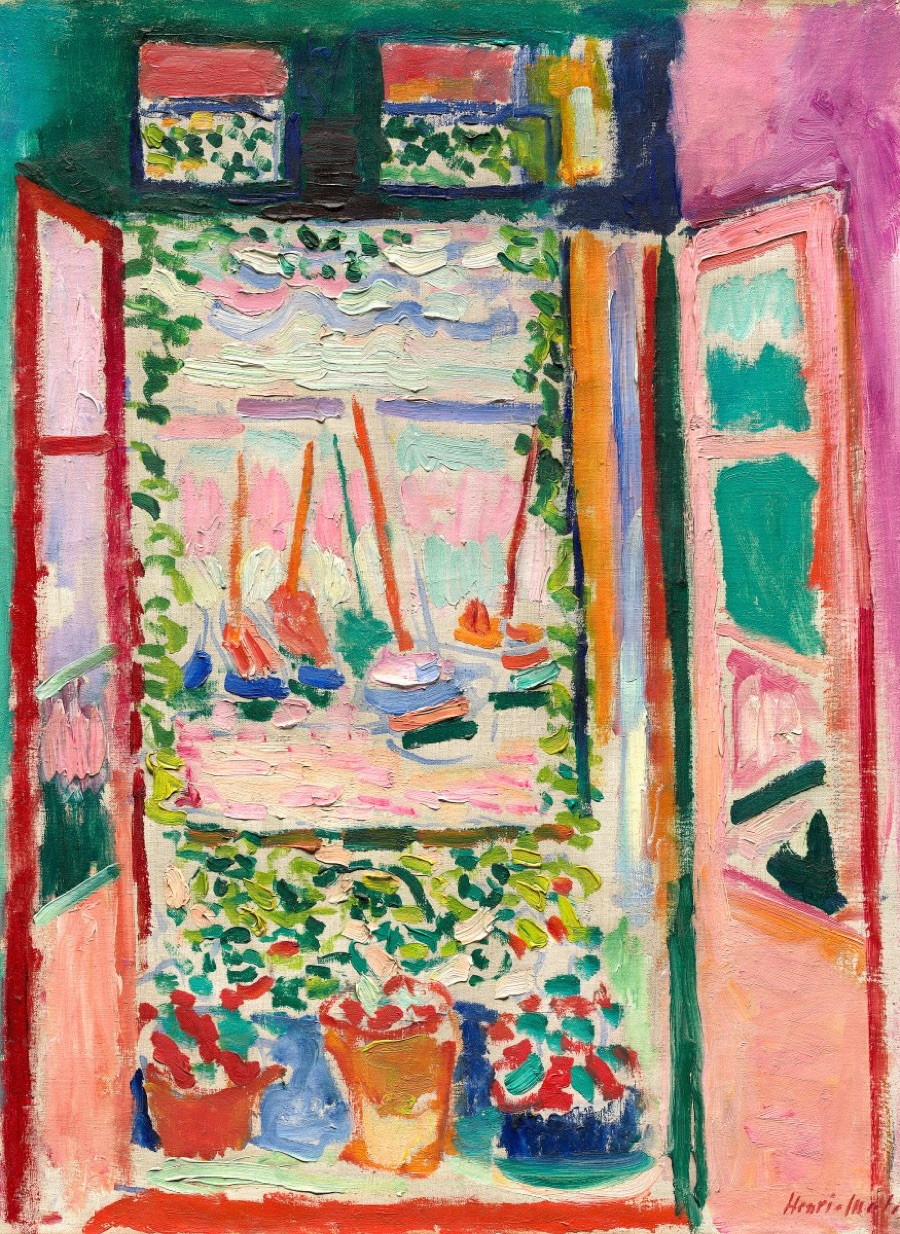
Some revolutions start with a manifesto. This one started with a view of fishing boats. The Open Window by Matisse, painted in 1905, shows nothing more dramatic than a window swung open onto a small harbor in the south of France. Yet the colors inside that modest frame were so loud, so unapologetically artificial, that they helped give an entire art movement its name. To understand Matisse Fauvism at its wildest, you start here, at this window.
A Summer in Collioure
In the summer of 1905, Matisse traveled to Collioure, a fishing village on the Mediterranean coast near the Spanish border. He worked there alongside the younger painter André Derain, and the southern light seems to have loosened something in both of them. Matisse painted the view from his window: boats bobbing in the harbor, their masts tilting, the water and sky rendered in strokes of pink and turquoise that no honest eye had ever seen there.
The picture flings the window open and lets the outside pour in. The interior dissolves into color. The walls to either side of the casement do not match, one reading as green, the other as violet, and the potted plants on the balcony flicker like small flames. Depth flattens. Light stops being an effect and becomes a physical presence, something with weight.
The Cage of Wild Beasts
That autumn, Matisse showed his Collioure work at the Salon d'Automne in Paris, hanging in a room with Derain, Vlaminck, and other like-minded painters. The response was somewhere between laughter and outrage. The critic Louis Vauxcelles, noting a conventional sculpture displayed amid all that blazing canvas, described the room as "la cage aux fauves," the cage of wild beasts.
The insult stuck, and the painters kept it. Fauvism was born as a taunt and survived as a badge of honor. The movement itself was brief, burning out within a few years, but it cracked open a door that twentieth century painting never closed. Color was free now. It did not have to describe. It could simply act.
Why the Color Felt Like a Scandal
It is hard, more than a century later, to feel how shocking this painting once was. We live surrounded by saturated color. But in 1905, viewers expected paint to behave, to record the world in plausible tones. A pink sea was not a style choice. It was a provocation.
Matisse was not painting what Collioure looked like. He was painting what it felt like to stand in a warm room with the Mediterranean glittering outside. Every hue is pushed past nature toward sensation, and the strokes sit apart from each other, letting the white of the canvas breathe between them. The scandal, in the end, was honesty of a different kind.
The Window Matisse Never Stopped Painting
The open window became one of the defining motifs of Matisse's long career. He returned to it again and again, in Nice, in interiors filled with goldfish and violins, in somber wartime canvases where the view goes nearly black. A window is a picture inside a picture, a frame within the frame, and Matisse clearly loved the puzzle of it: where does the room end and the world begin?
In this first great version, the answer is that they do not end at all. Inside and outside share the same palette and the same flat, radiant surface. The boundary simply melts.
Where to See It Today
The Open Window now hangs in the National Gallery of Art in Washington, D.C. It is a surprisingly small canvas for a painting with this much historical weight, and visitors often walk past larger works to stand in front of it. In person, the colors still hum. Few paintings from 1905 feel this fresh.
Solving The Open Window Piece by Piece
There is another way to spend time with this painting, and it is slower and stranger than looking. Solve it as a jigsaw puzzle and you are forced to handle Matisse's decisions one at a time. You hold a piece of improbable pink and hunt for its place. You discover that the green wall and the violet wall really are different, because your eyes must tell them apart to finish the picture. The boats resolve last, little calligraphic squiggles that suddenly snap into sails.
The Open Window is included in the free Art Lovers collection in Artizen, an art jigsaw puzzle app for iPhone and iPad. Piece by piece, the window opens again, and the wild color that once scandalized Paris turns out to be a very good way to spend a quiet evening.
More stories from the collection: read about Hokusai's waterfalls and Klimt's Pear Tree, or browse all 12 painting stories.

