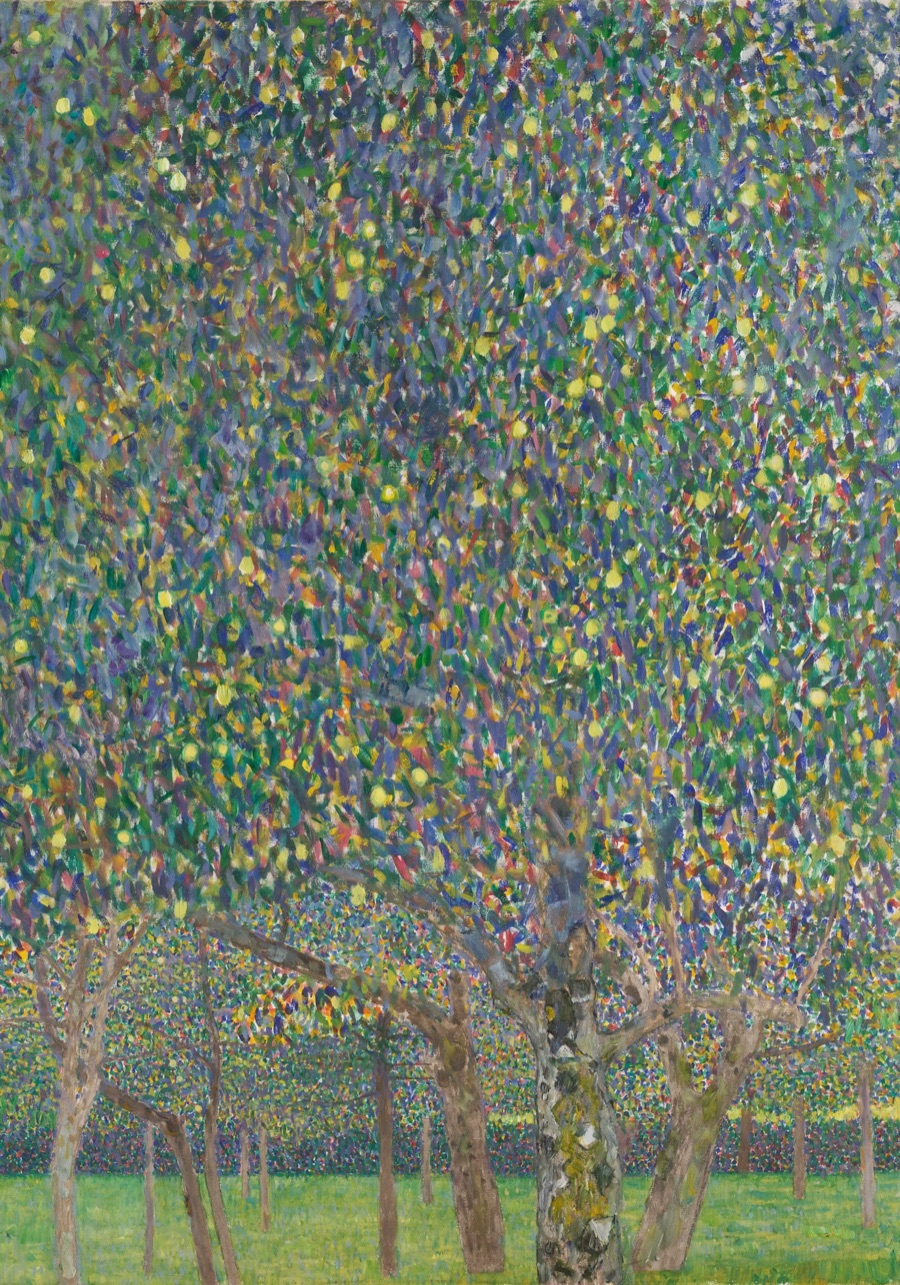
Say the name Klimt and most people picture gold leaf, embracing lovers, and the glittering portraits of Viennese society. Pear Tree, painted in 1903, shows a completely different artist. There is no gold here, no famous sitter, no scandal. Just an orchard tree so dense with leaves and fruit that it nearly swallows the entire canvas. And yet it is unmistakably Klimt, maybe more purely Klimt than anything else he made.
The Other Half of Gustav Klimt
Klimt's landscapes are his best-kept secret. Around a quarter of his painted output consists of landscapes, a fact that surprises almost everyone who knows him only through The Kiss. He came to the genre relatively late, in his mid-thirties, and then returned to it every year for the rest of his life.
The landscapes were personal in a way his portraits could not be. No commission, no client to flatter, no committee to satisfy. He painted them for himself, and it shows. They are quiet, obsessive, and strange, and Pear Tree is one of the finest of them all.
Summers at Lake Attersee
Nearly all of Klimt's landscapes came out of his summer holidays. Each year he left Vienna for the Salzkammergut region, spending long stretches at Lake Attersee with the family of Emilie Flöge, his lifelong companion. There he swam, rowed, walked, and painted.
These were working vacations in the gentlest sense. Klimt would set up outdoors and study whatever caught his eye: a farmhouse, a stand of birches, the surface of the lake, a fruit tree heavy with summer. Pear Tree belongs to this world of unhurried looking. You can almost feel the stillness of a warm afternoon in it.
Why the Square Canvas?
Klimt favored a square format for his landscapes, and Pear Tree follows that rule. It is a curious choice for landscape painting, which traditionally stretches wide to suggest distance and horizon. The square refuses all of that. It has no natural direction, so the eye does not sweep across the scene but settles into it.
The effect is contemplative rather than panoramic. A square Klimt landscape feels less like a window and more like an object, something complete in itself. It invites the same kind of attention you would give a decorated panel or an icon, which is exactly how Klimt treated his humble pear tree.
A Tree That Dissolves Into Pattern
Stand back from Pear Tree and you see an orchard. Step closer and the tree falls apart into thousands of small touches of paint: green on green, flecks of yellow fruit, scattered light. The branches swell until foliage fills nearly the whole picture, leaving only a thin strip of meadow below. The tree stops being a tree and becomes a shimmering, mosaic-like field of color.
This all-over pattern is where Klimt's decorative instincts and his love of nature meet. He treats a simple fruit tree as if it were a sacred image, nature turned into ornament, a piece of jewelry made of leaves. It is not really a picture of a place at all. It is a meditation on abundance, growth, and time, told entirely through pattern and color.
From an Austrian Orchard to Harvard
Today Pear Tree hangs far from the Salzkammergut. It belongs to the Busch-Reisinger Museum at Harvard University, the only museum in the Americas devoted to art from the German-speaking world, making it one of the rare Klimt landscapes you can see in the United States.
The painting also carries a small mystery in its surface. Klimt returned to the canvas around 1918, some fifteen years after he first painted it, and reworked parts of it. He died that same year, which makes Pear Tree both an early landscape and, in a sense, one of his last. Few paintings hold the beginning and the end of an artist's mature career in a single frame.
The Puzzle That Fights Back
Here is a confession from people who assemble paintings for a living: Pear Tree is one of the hardest jigsaw puzzles you can attempt. That dappled, all-over pattern that makes the painting so hypnotic on a museum wall becomes a beautiful trap on a puzzle board. Almost every piece is a variation on green and gold. There is no sky to anchor you, no clear edge between objects, just subtle shifts in tone and texture. It is a puzzle lover's dream and nightmare at once.
That is also what makes it so satisfying. Solving it forces you to look at the painting the way Klimt built it, one small patch of color at a time, until the tree slowly reassembles itself under your fingers. If you want to try, Pear Tree is included in Artizen's free Art Lovers collection, so you can download Artizen on the App Store and start placing leaves right away. Fair warning: the meadow strip at the bottom is the easy part. Everything above it is pure, glorious Klimt.
More stories from the collection: read about Renoir's Julie Manet and the portrait of Picasso, or browse all 12 painting stories.

