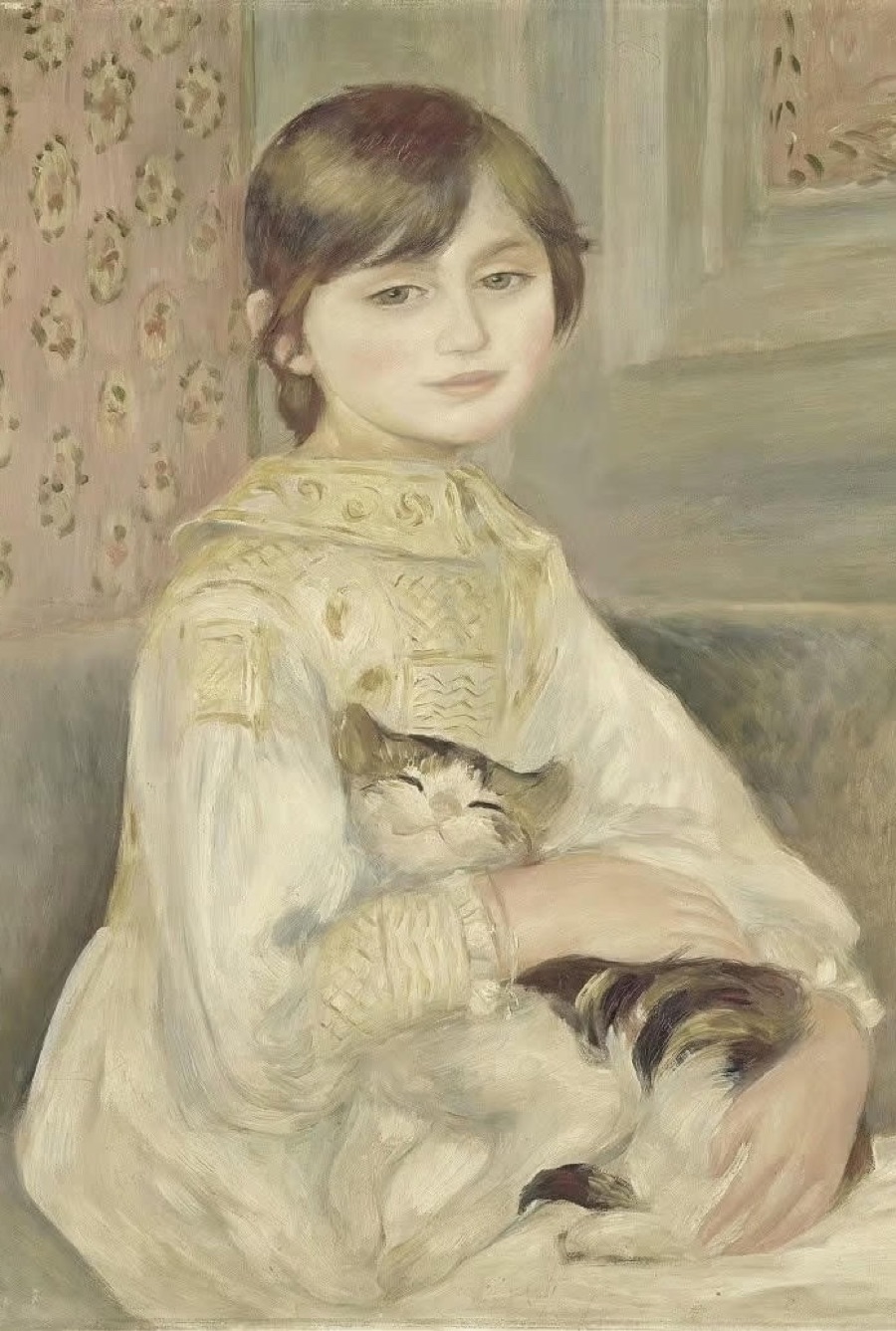
In 1887, Pierre-Auguste Renoir painted a nine-year-old girl cradling a sleeping cat. The portrait, known as Julie Manet or Child with Cat, looks at first like a simple study of childhood. But the sitter was no ordinary child. Julie Manet grew up at the very center of Impressionism, and her long life would quietly shape how we remember the movement today.
A Child Born into Impressionism
Julie Manet was the daughter of Berthe Morisot, one of the founding painters of Impressionism, and Eugene Manet, brother of Edouard Manet. That family tree alone tells you something. Her mother exhibited alongside Monet and Degas. Her uncle painted Olympia and scandalized Paris. The guests at her parents' home were the people who were rewriting the rules of painting.
So Julie did not just sit for portraits. She grew up inside them. Her mother painted her constantly, from infancy through her teenage years, and other artists in the circle painted her too. Few children in history have been observed with so much affection by so many great painters.
Renoir, the Family Friend
Renoir was especially close to the Morisot-Manet household. He and Berthe Morisot admired each other's work and exchanged visits for years, and Renoir painted Julie more than once. That closeness shows in this portrait. There is nothing stiff or commissioned about it. Her direct gaze, framed by soft hair and enveloped in warm color, suggests both shyness and quiet confidence. Rather than a formal society portrait, the work feels like a private moment within an artistic family, where affection and painterly delight in light and skin are inseparable.
The cat matters too. Renoir catches it mid-nap, utterly limp and content in Julie's arms, and the animal's ease tells us something about the child holding it. Cats do not relax like that for just anyone.
Orphaned, Then Raised by a Poet
Julie's charmed childhood ended early. Her father died when she was a teenager, and her mother followed in 1895, when Julie was sixteen. Berthe Morisot, on her deathbed, entrusted her daughter to friends. The poet Stephane Mallarme, one of the great figures of French literature, became her guardian.
It is a detail that sounds invented but is not. The orphaned daughter of an Impressionist painter, raised under the eye of a Symbolist poet, still surrounded by Renoir, Degas, and Monet. Her adolescence reads like a who's who of French art and letters, except she was living it, and grieving through it.
The Diary That Preserved a World
Through those years Julie kept a diary, and it became one of the most valuable documents we have about the Impressionists as people. Published in English as Growing Up with the Impressionists, it records dinner conversations, studio visits, and the small daily kindnesses of artists we otherwise know only through their canvases. Renoir appears in its pages not as a legend but as a warm, familiar presence.
Julie lived until 1966, long enough to see Impressionism go from ridiculed to beloved. She spent much of that long life protecting her mother's legacy, helping to secure Berthe Morisot's place in museum collections and in art history. The girl in the portrait became the keeper of the whole story.
Seeing the Painting Piece by Piece
There is a particular pleasure in solving this painting as a jigsaw puzzle, because it forces you to slow down where Renoir slowed down. Assemble the pieces of Julie's face and you notice how softly he blends skin into shadow, with edges that seem to breathe rather than end. Work through the cat and you find the brushwork loosens, a few relaxed strokes standing in for fur, the whole animal painted with the same drowsy contentment it displays. Details you would walk past in a museum become things you hold, turn, and place with your own hands.
Julie Manet is included in Artizen's free Art Lovers collection, so you can piece together Renoir's brushwork yourself, from 8 relaxed pieces up to a properly challenging 48. Artizen is free to download on the App Store.
Why This Portrait Endures
Plenty of nineteenth-century portraits of children survive. Most feel like performances, the sitter posed and polished for posterity. This one does not. Renoir painted a girl he knew well, in a home he loved visiting, holding a cat that trusted her completely. Knowing what came next, the early losses, the diary, the decades spent guarding her mother's name, only deepens it. The painting caught Julie Manet at the last calm moment of her childhood, and it caught her honestly.
More stories from the collection: read about the portrait of Picasso and The Table by Juan Gris, or browse all 12 painting stories.

