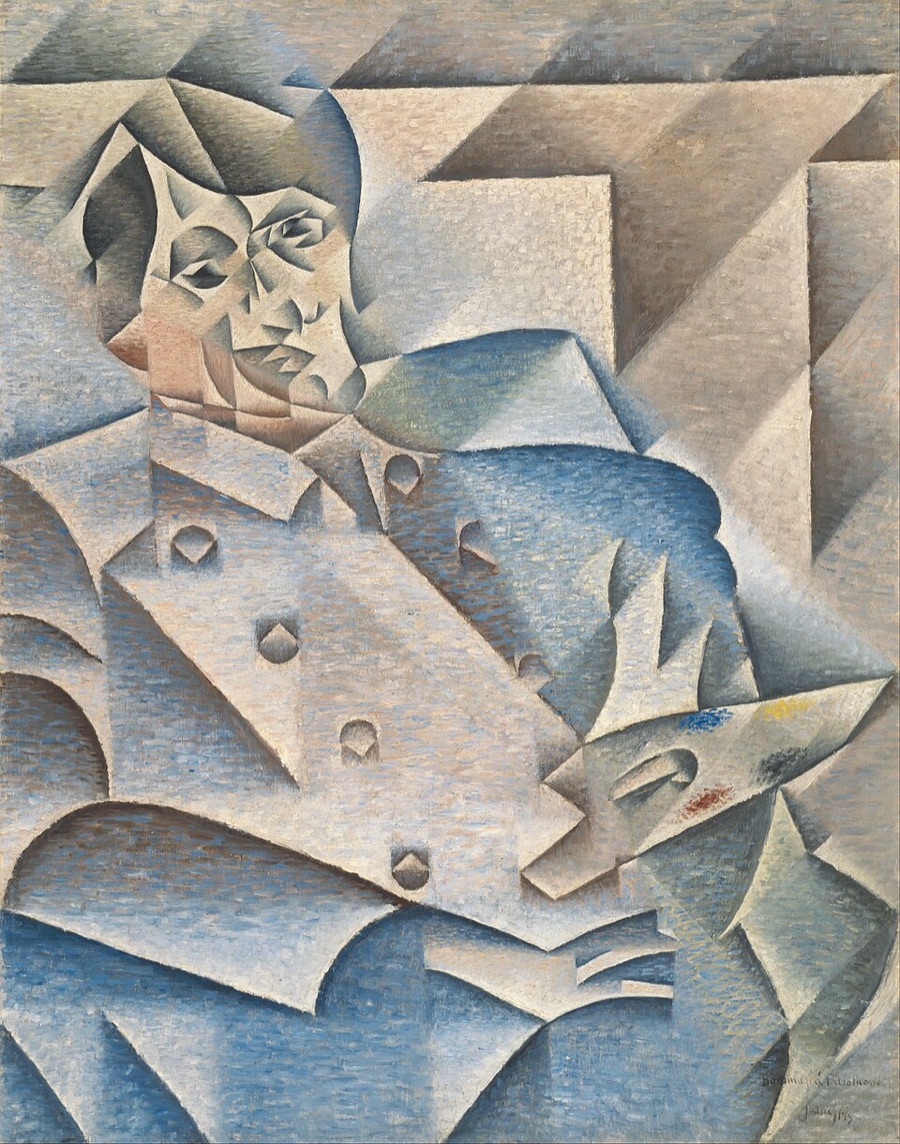
In 1912, a young Spanish painter named Juan Gris did something quietly audacious. He painted a portrait of Pablo Picasso, the most famous artist in Paris, using the very style Picasso had helped invent. The result, Portrait of Pablo Picasso, is one of the great documents of early Cubism: a tribute, a calling card, and a gentle challenge all folded into one canvas of shimmering blue-grey planes.
Cubism Painted in Cubism's Own Language
Most portraits of famous artists were made in flattering, conventional styles. Gris took the opposite path. He depicted Picasso through the visual language that Picasso and Georges Braque had been forging over the previous few years: flattened planes, simplified forms, and clear contrasts of tone. The face is broken apart and reassembled, yet somehow it still reads as Picasso, with his dark hair and steady gaze intact beneath the fractures.
The portrait captures not so much a likeness as a dialogue. Gris was showing that he understood Cubism deeply enough to speak it fluently, and that he could say something new with it. Picasso appears both constructed and alive, a figure assembled from the building blocks of modernism itself.
Two Spaniards in Montmartre
The two men knew each other well. Gris, born in Madrid, arrived in Paris in 1906 and settled in the Bateau-Lavoir, the ramshackle building in Montmartre where Picasso, a fellow Spaniard from Malaga, already lived and worked. For years they were neighbors in one of the most fertile artistic communities Europe has ever produced.
Gris spent his early Paris years drawing illustrations for magazines to pay the rent, all the while watching Cubism take shape a few doors away. When he finally committed himself to painting, he did so with the discipline of someone who had studied the movement from the inside. This portrait was the proof.
Hommage a Pablo Picasso
Look at the lower right of the canvas and you will find an inscription: "Hommage a Pablo Picasso." It is a dedication, plain and public. Gris was acknowledging his debt to the older artist openly, in paint, on the very surface of the work.
But an homage written in your own confident hand is also a statement of arrival. By dedicating the painting to Picasso while demonstrating complete command of Picasso's idiom, Gris positioned himself not as a follower but as a peer. The inscription honors the master and, in the same breath, announces a rival.
The Painting That Announced Juan Gris
Gris exhibited the portrait at the Salon des Independants in Paris in 1912, and it marked his emergence as a serious force in the Cubist circle. Until then he had been the quiet one, the illustrator, the neighbor. After the Salon, nobody could dismiss him.
His timing was pointed. Picasso and Braque did not show their work at the big public salons, preferring to sell through their dealer. So when Parisians came to see what this Cubism business was about, it was often Gris and painters like him who represented the movement in public. With this portrait, Gris effectively introduced Picasso's revolution to a wider audience, in his own crystalline version of it.
A Friendship With an Edge
The relationship between Juan Gris and Picasso was warm but never simple. Picasso could be generous with younger artists and fiercely territorial at the same time, and Gris developed Cubism in a direction all his own: cooler, more ordered, more mathematically precise than Picasso's restless improvisations. Critics began to praise Gris as the purest of the Cubists, which was not always comfortable for the man who started it all.
Gris died young, in 1927, at just forty. His reputation has only grown since. And this portrait remains the perfect emblem of their bond: one great painter seen through the eyes, and the style, of another.
Where the Portrait Lives Today
Portrait of Pablo Picasso now hangs in the Art Institute of Chicago, where it is one of the museum's touchstones of early modern art. Notice what Gris put in Picasso's hands: a palette. He painted the painter as a painter, tools at the ready, mid-thought. It is a small detail, but it tells you exactly what Gris admired. Not the celebrity, the worker.
See the Portrait Piece by Piece
There is a fitting irony in solving this painting as a jigsaw puzzle. Gris broke Picasso's face into fragments; a puzzle asks you to put those fragments back together. As you work, you start to see the portrait the way Gris built it. You notice how a cheekbone becomes a cool blue-grey plane, how the planes tilt and catch light like cut crystal, how the palette in Picasso's hand anchors the whole composition. Piece by piece, the logic of Cubism stops being abstract and becomes something your hands understand.
You can try it yourself. Portrait of Pablo Picasso is included in the free Art Lovers collection in Artizen, an art jigsaw puzzle app for iPhone and iPad. Pick a piece count that suits your mood, and spend a quiet half hour reassembling one of the founding portraits of modern art.
More stories from the collection: read about The Table by Juan Gris and the portrait of Josette Gris, or browse all 12 painting stories.

